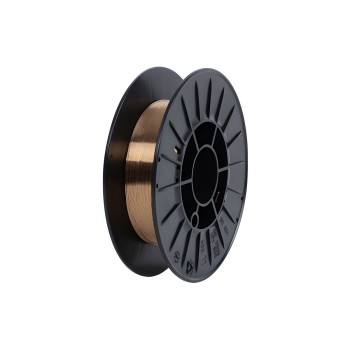
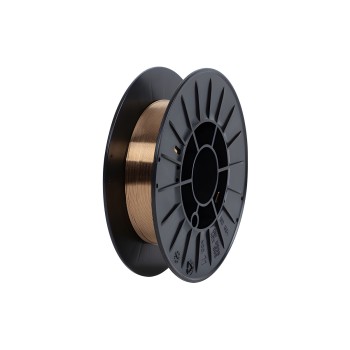
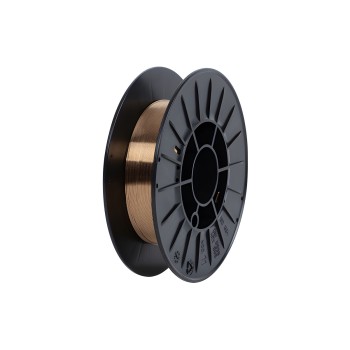
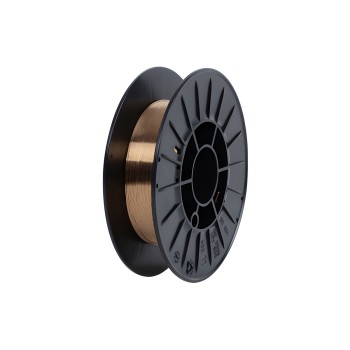
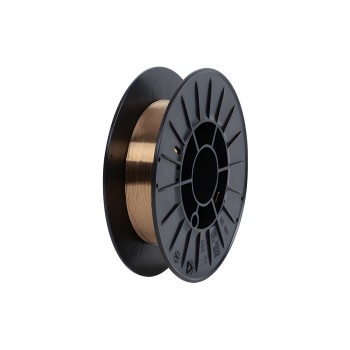
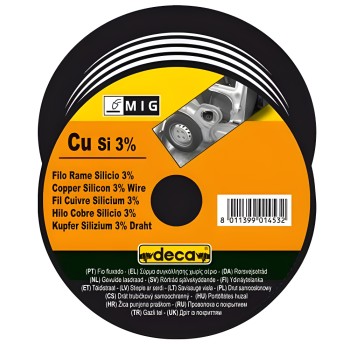
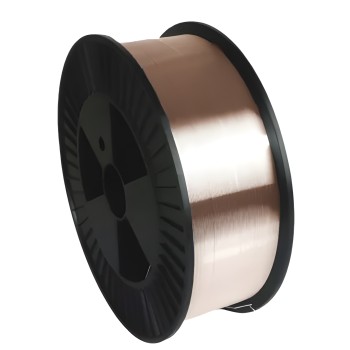
Flux-cored bodywork wire and MIG brazing wire are the consumables suited to semi-automatic automotive repair. Designed for thin sheet metal without distortion, they deliver a clean and strong weld. Discover our selection of wires for bodywork welding.
What is MIG brazing?
MIG brazing (or MIG-braze welding) uses a copper-silicon-based wire (CuSi3) that melts at a lower temperature than steel. The base metal does not melt: it is assembled by brazing. The result: minimal distortion, reduced heat input and a nearly invisible finish, ideal for bodywork welding on thin and galvanized sheet metal, without damaging the anti-corrosion protection.
Flux-cored wire for bodywork
Flux-cored bodywork wire is an alternative for welding automotive panels without gas. It generates its own shielding, which is practical for small occasional outdoor repairs. However, the finish is less aesthetically pleasing than with MIG brazing or solid wire under gas. For quality repair, MIG brazing remains the benchmark in the workshop.
Why avoid conventional MIG welding on thin sheet metal?
Conventional MIG welding (steel with argon-CO₂ gas) delivers a lot of heat to thin bodywork sheet metal. The risk is twofold: panel distortion and destruction of the anti-corrosion zinc coating. MIG brazing, with its reduced heat input, and the spot resistance welder limit these risks. This is why body shops prefer these processes.
Gas and settings
MIG brazing is used with pure argon or a specific mixture. The MIG-MAG welder settings must be precise: low voltage, appropriate wire speed, and a short arc to limit heat. Professional automotive welders often feature a dedicated MIG brazing mode, which makes setting up easier.
Typical applications
Flux-cored bodywork welding or MIG brazing covers many repairs: partial panel replacement, welding of galvanized sheet metal, assembly of thin body panels. MIG brazing is also used in decorative sheet metal work and HVAC for thin sheet metal. Combined with a spot welder, it forms the reference duo in automotive repair.
MIG brazing and modern steels
Modern car bodies use high-yield-strength steels (HYS) and galvanized sheet metal. MIG brazing is particularly well suited to these materials: its low temperature avoids altering the mechanical properties of HYS steel and does not destroy the zinc coating. This is why manufacturers often recommend this process for repairing their recent vehicles. A professional automotive MIG welder with a brazing mode is the ideal tool.
Choosing your bodywork wire
The choice between flux-cored bodywork wire and MIG brazing wire depends on the workshop and the job. For quality repair, CuSi3 wire with gas is the benchmark. Flux-cored wire is suitable for occasional outdoor repairs. In all cases, choose a fine diameter (0.6 to 0.8 mm) to limit heat input on thin sheet metal. Check compatibility with your welder and your MIG accessories.
Avoiding distortion
The body repairer's greatest fear is distortion of thin sheet metal. MIG brazing, with its low heat input, considerably reduces this risk. But even when brazing, proper settings are essential: short arc, appropriate speed, and steady travel. If in doubt, always test on a scrap piece of similar sheet metal before working on the vehicle. Mastering the settings makes the difference between an invisible repair and a distorted panel.
CuSi3 wire, a standard
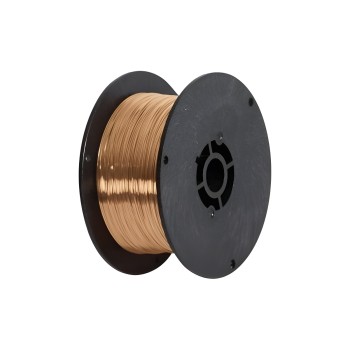
CuSi3 wire (3% copper-silicon) is the standard for MIG brazing. Its golden color and low melting temperature make it an easily identifiable consumable. It produces a clean bead that grinds and finishes well. Combined with the right gas (pure argon), it is the reference solution in bodywork welding for modern vehicles.
For the majority of common automotive repairs, MIG brazing with CuSi3 wire is the solution recommended by manufacturers and adopted by approved workshops as the benchmark.
Our advice
For bodywork repair, MIG brazing (CuSi3 wire) is the benchmark: reduced heat, minimal distortion, zinc protection preserved. Flux-cored bodywork wire works outdoors in a pinch but falls short on finish quality. Choose according to your equipment and needs. Browse our selection of bodywork and MIG brazing wires.
Frequently asked questions
What is MIG brazing?
A MIG process that uses a copper-silicon wire (CuSi3) melting at a lower temperature than steel. The base metal does not melt: it is assembled by brazing, with reduced heat input and minimal distortion, ideal for thin and galvanized sheet metal.
Why use MIG brazing in bodywork?
Because it heats less than conventional MIG welding, which avoids distortion of thin sheet metal and preserves the anti-corrosion zinc coating. The result is a clean and nearly invisible weld, meeting the requirements of automotive repair.
Can bodywork be welded with flux-cored wire?
Yes, flux-cored bodywork wire allows welding without gas, which is practical outdoors for small repairs. But the finish is less aesthetically pleasing than with MIG brazing or solid wire under gas. For quality repair, MIG brazing remains the benchmark.
Which gas should be used for MIG brazing?
Pure argon or a specific mixture, depending on the wire and the welder. Settings must be precise: low voltage, short arc, appropriate wire speed. Professional automotive welders often feature a dedicated MIG brazing mode.


 Italy
Italy
 Germany
 Netherlands
 Croatia
 Denmark
 Finland
 Greece
 Ireland
 Portugal
 Norway
 Bulgaria
 Estonia
 Latvia
 Lithuania
 Poland
 Czech Republic
 Romania
 Slovakia
 Slovenia
 Hungary
 Spain
Spain



 2-year warranty