Tungsten Inert Gas (TIG) welding is an innovative process that provides welders with serious advantages in the practice of their trade. Indeed, TIG welding allows you to work with precision and an excellent finish. Easy to use and applicable in all positions, TIG welding is based on a relatively simple principle. It primarily requires the use of argon-based gas as well as a tungsten welding electrode. The former preserves the weld pool from the surrounding air while the latter serves to melt the metal. The electrode plays a primary role in obtaining the electric arc and is decisive in terms of weld quality. There are electrodes for different types of metals, each with their own advantages.
However, why change the electrode each time when welding different metals if you can do it with just one? Yes, this is possible, and we will tell you more about the tungsten electrode for all metals in the rest of this article.
What is the purpose of an electrode?
Also called a welding rod, the electrode is the filler metal required for welding. It is used to join two independent steel elements for welding. It is inserted into the clamp of a professional MIG welding machine, for example, and depending on the metal to be welded and its thickness, it is traversed by an electric current at a varying intensity. Thanks to the generated electric arc, the electrode melts when it comes into contact with the grounded metal.
What is it made of?
As mentioned above, an electrode in welding serves as a filler metal. To do so, it is composed of:
- A metal core which is the central element of the electrode;
- A friable coating that surrounds the core.
Generally, the core must be compatible with or made of the same material as the metal to be welded. The friable coating, although used to surround the core, is the main element of the welding rod. During welding, it is responsible for preserving the arc. It also serves as an electrical conductor during ignition. Depending on the welding position (flat, downward, overhead horizontal, or upward), the coating allows the arc to be directed with precision. Finally, thanks to a slag that rises to the surface, the coating effectively protects the weld pool.
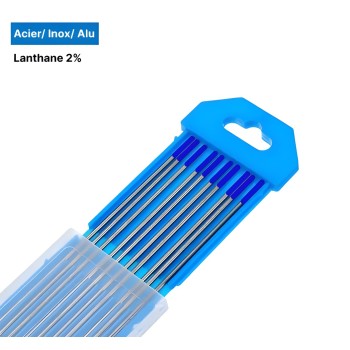
The WL15 Tungsten Electrode (Lanthanum)
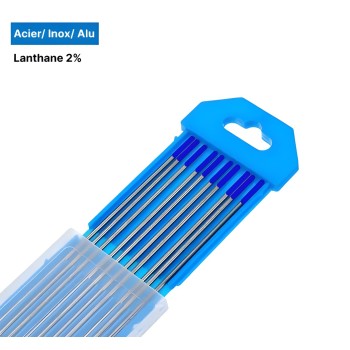
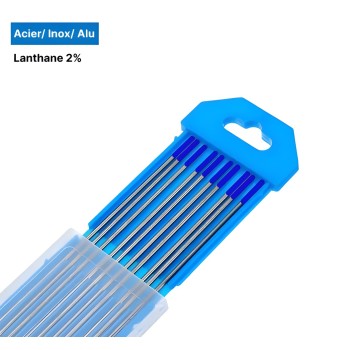
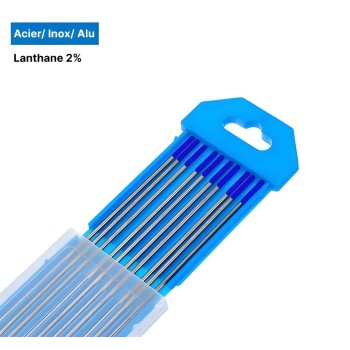
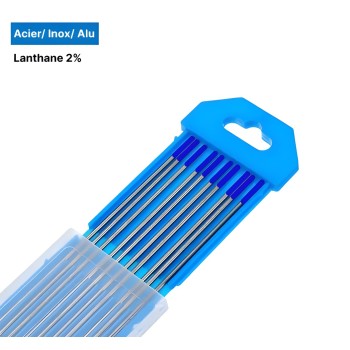
Usually blue or gold, Lanthanum Tungsten welding electrodes are versatile and universal TIG welding rods. Unlike standard models which are only suited to certain types of metals, WL15 tungsten electrodes can weld all types of metals and are used in both direct current (DC) and alternating current (AC). Aluminium, Copper, Magnesium and Titanium, to name but a few, can be welded in pure materials or in alloys thanks to the universal electrode. These have a surprisingly slow wear rate as well as a more energy-efficient arc starting than WR2 electrodes (which are another category of versatile electrodes). This is due to the high level of lanthanum oxide incorporated in their composition. However, they are recommended for low currents.
WL15 tungsten welding electrodes also meet the requirements of small repair jobs, workshop welding tasks, as well as on-site work. They provide the user with a significant margin in the event of handling errors through good ignition capacity. The universal tungsten electrode is also used in highly professional industries, where it is intended to be used by robots with a high degree of standardization.
Advantages and characteristics of the versatile tungsten electrode
Universal electrodes are suited to welding metals in steel, brass, copper, stainless steel, etc. They offer a welding mode at low or medium intensities. It is also possible, thanks to these tungsten electrodes, to weld aluminium in alternating current. In addition to being non-radioactive, these welding rods suited to all metals have properties similar to those of the thoriated electrode. However, versatile tungsten welding rods stand out from others thanks to their excellent arc ignition quality. Perfect for automatic welding, they ensure excellent consistency in the production of the weld bead.
The selection criterion for the universal tungsten electrode
Undoubtedly, "the most important factor" in choosing a tungsten welding electrode is its quality. This criterion has a direct impact on ignition capacity, service life, and the quality of the electric arc. It is also based on the quality of the electrode that the welding result will or will not be optimal. In welding, it is generally difficult to spot certain quality defects with the naked eye. In such cases, the only recourse would be a thorough metallurgical analysis. However, here are the main quality indicators for a tungsten electrode:
- Surface quality: this criterion requires designers to present electrodes with a surface roughness governed by regulations. The surface of these must be absolutely polished and free of impurities.
- The electrode's solidity: this element is essential for a tungsten welding electrode because control of the electric arc and successful sharpening depend on this aspect.
- Composition: this, also governed by regulations, makes it possible to determine whether or not electrodes are pure. The objective is for the composition of the electrodes to prevent the formation of droplets in the weld pool.
- Manufacturing: among the most common manufacturing defects, there is the non-homogeneous distribution of oxide additives or sintering errors in the electrode.
The tungsten electron sharpening process
Electrode sharpening is an essential phase of TIG welding. The reason is that the quality of the bead will strongly depend on it. Thus, the sharpening of the electrode tip differs when welding with alternating current compared to welding with direct current. However, regardless of the situation, the striations resulting from grinding must run along the direction of the electrode and must follow a determined angle with a flat. This is essential in order to avoid tungsten inclusions within the weld bead. The welding rod must therefore follow a specific geometry.
What sharpening angle should be observed?
The geometry of the bead and the characteristics of the electric arc are directly or indirectly subject to the influence of the sharpening angle. This is therefore very important throughout the entire welding process. Generally, welding specialists opt for electrodes whose tip has an angle of between 15 and 45˚. An angle exceeding this range leads to a cylindrical arc column, while an angle below this range will widen the arc and lead to a more conical arc column.
As regards industry and its automated processes, the sharpening angle is determined in order to ensure good stability and a long service life of the electric arc. To achieve this stability, the electrode is always sharpened along the longitudinal direction. Furthermore, be careful not to sharpen it perpendicularly to the axis. This could make the arc unstable and erratic, and would lead to a random welding finish. The electrode is then polished to obtain a good service life.
The flat
The position of the flat at the tip of the welding electrode is essential. It is determined by taking into account the current density used. If the electrode is sharp and well sharpened, arc ignition is achieved much more easily. On the other hand, after a certain time, it degrades and leads to risks of tungsten inclusion within the weld. When the flat is significant, this helps to increase the service life of the electrode. Furthermore, if the flat is too large or too wide relative to the current, the electric arc becomes poorly directive and fairly unstable.
It is therefore only natural that a stable electric arc requires a suitable flat. Choosing the right flat would also allow precise electron transfer and a longer service life for the electrodes without fear of a tungsten welding inclusion. As a final criterion, it is important to take into account the contact tip-to-electrode distance. This also influences the bead width through the increased arc voltage and, by extension, the inner/outer width ratio of the bead.
Tungsten electrode: what is the ideal stick-out length?
In order to be protected from the gas, it is important to observe the nozzle-to-electrode distance. If the electrode stick-out length is too short, the arc will be smothered and the ceramic nozzle will overheat. On the other hand, if this length is too long, the arc will lose its concentration effect and there will be virtually no protection of the weld pool or the electrode. The adequate length represents 2 to 3 times the diameter of the electrode. In theory, this is the ideal solution when bevels have a depth that allows it.


 Italy
Italy
 Germany
 Netherlands
 Croatia
 Denmark
 Finland
 Greece
 Ireland
 Portugal
 Norway
 Bulgaria
 Estonia
 Latvia
 Lithuania
 Poland
 Czech Republic
 Romania
 Slovakia
 Slovenia
 Hungary
 Spain
Spain



 2-year warranty