For all DIY enthusiasts and particularly for welders, it is essential to maintain their working tools. Especially when it comes to cutting tools, these, after a certain period of use, become ineffective and less safe. Therefore, it is important to maintain them by performing regular grinding and sharpening. And what better tool to carry out these various tasks than a bench grinder? This tool can find its place both in a workshop and in a home. In either situation, the use is virtually the same. Would you like to know more? The rest of the article will tell you everything about this tool.
What to know about the bench grinder?
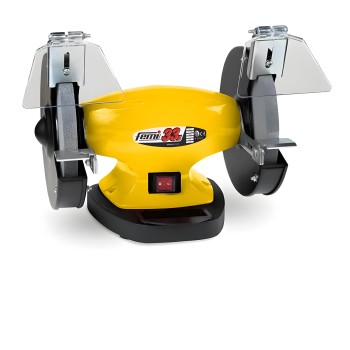
A bench grinder is a machine used in many processes. It is equipped with a motor of variable power depending on the model. The latter drives one or two grinding wheels whose role is either to sharpen cutting tools or to shape metal parts. Again depending on the type, it is a tool that may or may not be fitted with speed reducers whose function is to prevent the metal from losing its temper.
What is it used for?
Although this accessory is known for sharpening cutting objects, it is also intended for many other uses.
Sharpening
The main function of the bench grinder is the maintenance of cutting objects. All professional craftsmen and households need one. You may ask why, and what is the connection? Both alike have cutting objects that they use almost daily. Whether it is a knife or a hacksaw, these objects, when used regularly, become blunt and lose their effectiveness when they are not frequently sharpened.
This is where the bench grinder comes in, allowing you to maintain these tools and preserve their effectiveness. This is the first use that can be made of this machine. It sharpens cutting objects when they come into contact with the grinding wheels rotating at high speed, driven by a motor.
Deburring
This process is used directly after a site grinder that may have left metal burrs after a major cut. Deburring will essentially consist of removing these.
Shaping
The purpose of shaping is to give a form to metal through a fine and well-crafted grinding operation.
Deburring
This is the same operation as deburring, with the difference that it removes the metal burr after filing or cutting with a hacksaw.
The different types of bench grinders?
We have just presented the main uses of bench grinders. With this in mind and with a view to achieving finishes suited to these different uses, manufacturers have developed three types of bench grinding machines.
The double bench grinder
This type of bench grinder is fitted with two grinding wheels generally fixed at each end. These are identical in every respect in that they are mounted on the same shaft and rotate at the same speed. Practical when you want to carry out different tasks in a short time. You therefore have the option of deburring on one wheel and shaping parts on the other, all at equal speed.
The combination bench grinder
The combination bench grinder is quite particular. It has two different grinding systems to suit your needs and the tasks required. Their speed may be shared. The combination bench grinder also allows you to combine functions such as:
- Abrasive belt shaping/polishing;
- Dry grinding/sharpening;
- Wet shaping/sharpening;
- Deburring/brushing;
- Several other combinations.
The sharpening bench grinder
The specificity of sharpening bench grinders is that they are designed for careful sharpening work thanks to their high-performance wheels rotating at very high speed. Among one of the wheels of this machine, one in particular is fitted with a water container for sharpening.
A few tips for choosing your bench grinder
The bench grinder being a multi-purpose machine, its selection depends on a number of criteria. Make sure you have the right model for the task you wish to perform.
According to the colour of the grinding wheel
The colour of this machine is an important indicator that varies according to the nature of the work to be carried out. We can thus distinguish:
- Grey grinding wheels: these are the wheels generally sold with the bench grinder. Their role is mainly to grind common steels;
- White grinding wheels: used for sharpening tools;
- Green grinding wheels: made of silicon carbide, these wheels are ideal for sharpening drill bits, blades and various types of tools;
- Brown-coloured grinding wheels: these are the ones intended for heavy deburring work.
Note that you should choose a grinding wheel colour according to its grain. Indeed, most of these machines operate dry. However, it should be noted that fine sharpening requires a wet grinding wheel. Dry or wet, make sure that the surface of your grinding wheel is straight. If this is not the case, there are dressing tools that will help you true it up. Finally, avoid grinding soft metals as much as possible. They are particularly well known for clogging grinding wheels.
According to frequency of use
Another determining factor, the frequency of use of your bench grinder will allow you to choose the power (expressed in watts) as well as the diameter of your equipment. For occasional or one-off use of the bench grinder, a grinding wheel with a diameter of 125 mm could be more than sufficient. However, do not go below a power of 250 watts as any measure below this threshold could stall the wheel. On the other hand, a machine with a diameter of between 200 and 250 mm and a sustained power of 500 watts would be suited to regular or professional use.
Keep in mind that your bench grinder must necessarily be secured to a workbench. If this is not possible, you can fix it to the floor using a base that will also allow you to use it.
According to the type of sharpening to be performed with the grinding wheel
Sharpening consists of honing the cutting edge of a tool. To do it properly, start by rough-grinding your tool on a grey wheel to give it its cutting shape. Then, on a white wheel, carefully refine the edge and use wet sharpening to adjust the cutting edge of the object without overheating it. Finally, perform deburring and leather polishing to remove small burrs and make the blade of your object shine.
It is only after understanding the importance of these different steps that you will appreciate that sharpening must be done without overheating. It can happen that during the grinding of a workpiece it turns blue, loses its temper and consequently its surface hardness. To remedy this, we recommend always having a container of water on hand to bring the temperature of the workpiece down.
How to use it?
Before you can use it, you must make sure that your bench grinder is firmly secured to your workbench so that it cannot move. The next step is to identify and fit the appropriate grinding wheel according to the task to be performed. Then start the bench grinder and let it run idle for a few seconds. The aim is to make sure it is working without any problems. Now bring the part to be shaped or sharpened towards the wheel running at full speed. However, do not forget that you must hold the workpiece firmly with both hands. If you are a beginner, we recommend starting small, in particular by using a sharpening rest.
Bench grinders with positioner
The concept behind the design of positioner bench grinders is quite straightforward. This equipment is a machine that vibrates considerably and whose grinding produces sparks and causes heat build-up on the machine, which is then transferred to the workpiece. Performing sharpening work requires dexterity. Thus, when used incorrectly, the machine can jam or at best swallow your workpiece. Hence the manufacture of positioners (which must be robust and adjustable). These are primarily guiding elements whose purpose is to ensure better positioning of the bench grinder. This feature is important for all tasks performed on the bench grinder, but is essential primarily for sharpening.
A few safety measures
First of all, we recommend always using the bench grinder in a well-ventilated area and away from any type of combustible material. Before each use, check that the machine's power cord is in good condition before plugging it in. Then also make sure that all safety devices are perfectly in place before starting the machine.
We also recommend — and this is undoubtedly the most important element — protecting your eyes, hands, ears and respiratory tract. Equip yourself with safety goggles, gloves, noise-cancelling ear defenders and dust masks.


 Italy
Italy
 Germany
 Netherlands
 Croatia
 Denmark
 Finland
 Greece
 Ireland
 Portugal
 Norway
 Bulgaria
 Estonia
 Latvia
 Lithuania
 Poland
 Czech Republic
 Romania
 Slovakia
 Slovenia
 Hungary
 Spain
Spain



 2-year warranty